The honest answer is that camera count is the wrong question. A four-camera system covering every way into the property beats an eight-camera system pointed at scenery. Plan coverage first and the number falls out of the plan by itself.
Count entry points, then count cameras
Walk the perimeter and write down every way a person can get onto the property and then into the building: the gate, the pedestrian door, the back door, the generator house, ground-floor windows facing a wall someone could climb.
Each of those needs to be covered by at least one camera whose job is identification, not atmosphere. Most Lagos homes end up somewhere between four and eight once the list is honest, and the distribution matters more than the total.
Know which cameras identify and which only observe
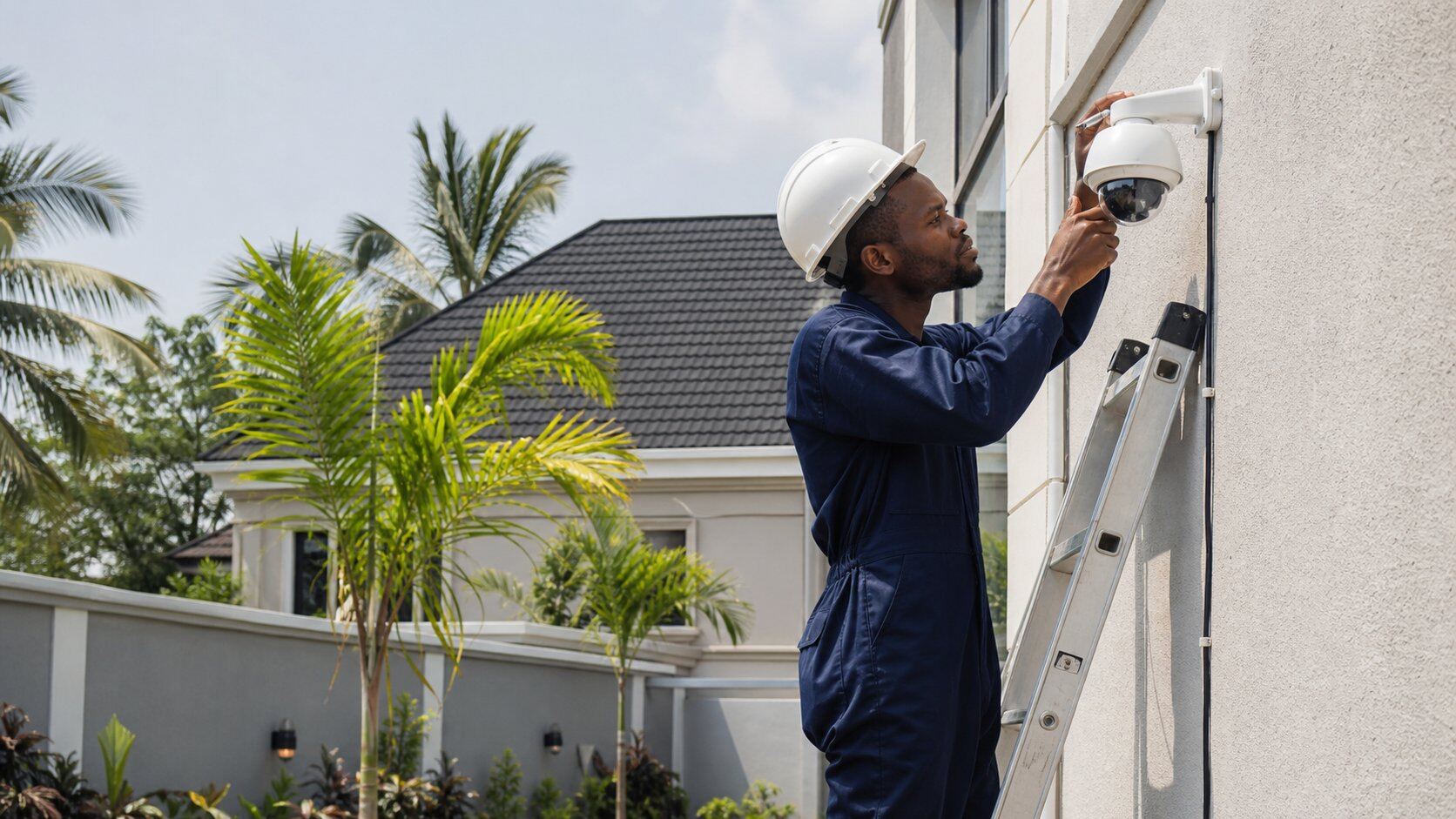
A camera at the gate should produce a face you could give to the police. That means it is mounted at head height on the approach, not on the roofline looking down at the top of a cap, and the subject fills a decent portion of the frame.
Wide overview cameras have a role — they tell you what happened and in what order — but they will not identify anyone. Every system needs both, and the mistake is buying six of the second kind and none of the first.
Resolution is about distance, not bragging rights
What matters is pixels across the subject, which depends on sensor resolution and how far away the subject is. A 2MP camera identifies a face reliably at a few metres. Push it to fifteen metres down a driveway and it produces a shape in a shirt.
So either move the camera closer to the choke point, or use a higher-resolution sensor or a longer lens. Buying 4K and mounting it badly wastes the money twice: once on the camera and again on the storage it fills.
Plan for night, because that is when it matters
Most incidents happen in the dark, and infrared illuminators have a real working range that is usually shorter than the box claims. Check the range against the distance you actually need, and watch for surfaces near the lens — a wall or gatepost inside the beam will bounce IR back and white out the whole frame.
Where there is ambient light, a camera with good low-light colour performance is worth more than raw resolution. Colour clothing and a colour vehicle are far more useful to an investigation than a grey silhouette.
The recorder and the cabling decide whether any of it works
A system is only as good as the parts nobody looks at:
- Retention: 14–30 days of continuous recording, sized deliberately, not left at whatever the box defaults to
- The recorder in a locked, ventilated position — not on the shelf by the front door where it can be taken
- Proper CAT6 or coax, run in conduit and labelled at both ends
- A UPS on the recorder and the router, so an outage is not a blind spot
- Remote viewing tested on your phone, on mobile data, before the crew leaves
Plan the coverage, not the quantity. Cover every entry point, make at least one camera per approach an identification camera, size retention deliberately, and put the recorder somewhere an intruder cannot simply walk off with it. Four cameras that do that are worth more than twelve that do not.